My Favorite Nurse Calls Me Mama SVG PNG
A Warm, Worn-In Design That Feels Like a Hug
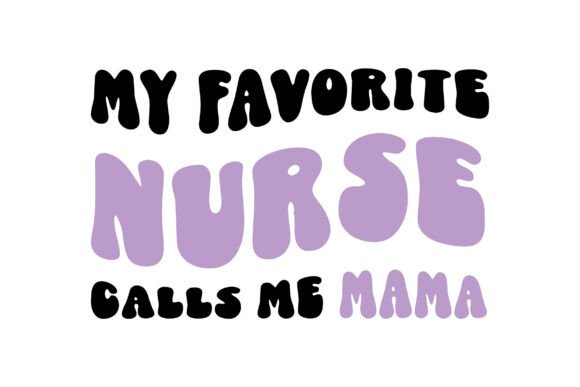
First impression? This isn’t a flashy, trend-chasing graphic—it’s soft, sincere, and quietly confident. The phrase “My Favorite Nurse Calls Me Mama” lands with gentle weight, not irony or edge. The lettering has subtle rounded edges and comfortable spacing—no cramped kerning, no fragile serifs. It reads clearly at 3–4 inches wide, which is ideal for sweatshirt fronts, tote bag centers, or baby onesie chests. There’s no clipart clutter: no stethoscopes, hearts, or cartoon nurses. Just clean, human-centered typography that leans into warmth over whimsy. That simplicity is its strength—and its first real test.
Where It Shines in Real Embroidery Projects
I recently prepped this design for a custom embroidered cotton tote for a nurse-mom client—something she’d carry to shifts and school pickups. We stitched it on natural canvas using a medium-weight cutaway stabilizer and matte poly thread. At 3.5 inches wide, the satin-stitched letters held crisp edges without pulling or puckering. The curves in the “M” and “a” flowed smoothly; no stitch stacking or distortion. It looked handmade—not machine-perfect, but intentionally crafted.
That same file translated well onto a French terry sweatshirt (medium-density fill stitch, slightly reduced density), a linen tea towel (lighter stabilizer, running stitch outline for definition), and even a twill patch sewn onto a denim apron. In each case, the design supported the product instead of competing with it. It didn’t scream “look at me”—it invited quiet recognition. That’s rare in sentimental designs, especially for healthcare workers who often get oversimplified visuals.
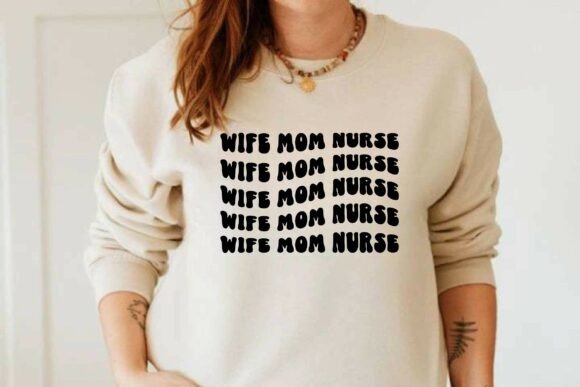
For Etsy sellers and small shop owners: this works beautifully as a digital embroidery file bundled with a printable mockup pack. Buyers appreciate seeing how it looks on a relaxed-fit women’s tee versus a unisex crewneck—especially when the design breathes well across both. As a Graphics asset, it pairs naturally with neutral palettes and minimalist branding, making it easy to drop into cohesive boutique collections.
Where to Pause—and Test First
Don’t assume it’s foolproof on every surface. On stretchy jersey or thin baby rib knit, the letterforms can blur if stabilizer choice or hooping tension isn’t dialed in. I recommend testing My Favorite Nurse Calls Me Mama SVG PNG on scrap fabric *before* stitching a finished baby onesie or toddler shirt. Also, avoid placing it near seams, curved hems, or cap crowns unless you’ve confirmed hoop clearance and fabric stability—the layout doesn’t lend itself to tight radiuses.
Dense fill areas (like the interior of the “O” or “A”) hold up well on stable fabrics, but on textured surfaces like bouclé or heavy terry, consider simplifying to an outline + satin border version—or switching to applique design logic for better dimension. And while it reads cleanly on light fabric, always preview the embroidery file in black-and-white mockups against dark backgrounds. Some subtle letterweight variations become less legible on navy or charcoal without contrast adjustment.
Design Integrity Matters More Than Speed
This isn’t just about whether the stitches line up—it’s about whether the finished product feels trustworthy. When a customer orders a personalized gift, they’re buying sentiment *and* craftsmanship. My Favorite Nurse Calls Me Mama SVG PNG supports that intention because it avoids visual noise. No extra flourishes distract from the message. That clarity builds buyer engagement: people pause, smile, read it aloud. That’s what makes it work for holiday embroidery (think: embroidered pillow covers for Mother’s Day), nursery decor, or even wedding gifts for nurse-brides.
But integrity also means checking licensing before listing it as part of your craft business offerings. Since it’s marketed as a T-Shirt Designs asset usable on “women, kids, baby or Birth,” confirm whether commercial embroidery rights are included—especially if you plan to sell physical embroidered patches or pre-made apparel. Never assume.
Practical Notes Every Embroidery Designer Should Keep Handy
- Always test My Favorite Nurse Calls Me Mama SVG PNG on scrap fabric matching your final project’s weight and stretch.
- Check thread color contrast early—especially for light-on-light or dark-on-dark applications. Matte threads enhance readability more than glossy ones here.
- Review stitch density before scaling. At under 2.5 inches wide, reduce density slightly to prevent stiffness on baby items.
- Confirm hoop size compatibility—this design fits comfortably in a 4×4 hoop at standard scale, but verify before loading into your embroidery machine.
- Inspect small details manually in your embroidery software: look for stray nodes, overlapping paths, or tiny unconnected elements that could cause jump stitches.
- Use proper stabilizer: cutaway for knits, tear-away for stable wovens, and lightweight fusible for delicate linens.
- Test both personal and commercial use cases—a design that works for a handmade product may need slight tweaks for high-volume custom apparel runs.
Final Thought: It’s Not Just a File—It’s a Moment Made Stitchable
My Favorite Nurse Calls Me Mama SVG PNG succeeds because it respects the weight of its own words. It doesn’t try to be everything—just something true, repeatable, and quietly meaningful. For embroidery designers building a library of reliable design assets, for Etsy sellers curating heartfelt collections, and for small shop owners crafting products with care: this is the kind of digital embroidery file that earns repeat customers. Not because it’s trendy—but because it stitches well, sells honestly, and feels like home.