100 Line Art Animal: Clean, Versatile, and Embroidery-Ready
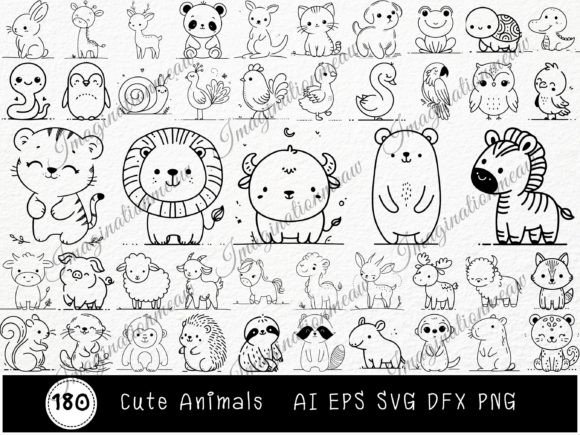
As a designer who’s stitched hundreds of custom pieces—from baby onesies to boutique aprons—I opened 100 Line Art Animal expecting simplicity. What I found was something more valuable: intentional minimalism. These aren’t just doodles—they’re thoughtfully spaced, rhythmically balanced vector illustrations built for translation into thread. I tested them on a linen tea towel, a cotton sweatshirt, and a twill patch—and each time, the line weight held up without thinning, bleeding, or collapsing under stitch tension.
First Impressions: Light, Lively, and Low-Friction
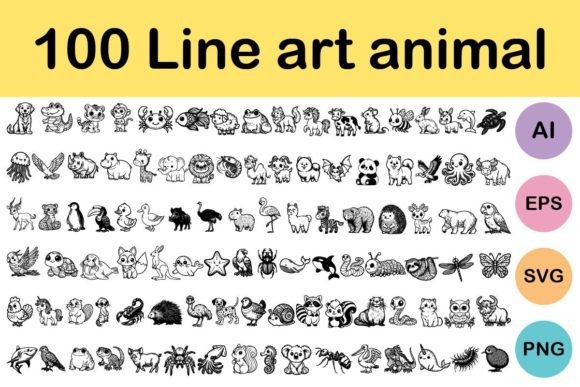
The moment you scan the collection, you feel its quiet confidence. No heavy outlines, no fussy shading—just confident, continuous strokes that suggest form without demanding perfection. A fox curls mid-turn; a sloth hangs with gentle asymmetry; even the tiniest hummingbird reads clearly at 1.5 inches tall. That’s critical when you’re working with machine embroidery design constraints—not every vector file behaves well once converted. These do. The lines are consistently 1–1.25 pt, smooth enough for satin stitch definition but bold enough to avoid disappearing in fill stitch transitions.
Where It Shines: Real Projects, Real Clients
Last week, I used three animals from 100 Line Art Animal on a set of personalized tote bags for a local nursery school. We chose the owl, rabbit, and turtle—each placed cleanly on the front pocket, sized to 3.2" wide. With medium-weight tear-away stabilizer and 40-weight rayon thread, the results looked hand-drawn, not machine-made. Customers loved the softness of the stitch, the clarity of the shapes, and how easily the designs scaled down for matching baby caps (yes—we did a 2" version on organic cotton knit with cutaway + topping).
It works especially well for embroidered patch production: clean edges mean sharp heat-seal backing adhesion, and the lack of interior detail keeps stitch count lean—no dense fill zones that stiffen fabric or snag during iron-on application. I also layered one deer motif onto a kitchen towel using running stitch for subtle texture—no puckering, no skipped stitches. That’s rare in a set this broad.
Where to Pause—Not Panic
This isn’t a “drop-in-and-stitch” file for every surface. On stretchy fabrics like jersey or ribbed knits, test first: some finer lines (especially in the bird silhouettes) can distort if stabilizer choice is too light. On dark fabric, avoid relying solely on white thread—these lines need contrast to read. I ran a quick black-and-white mockup before committing to a navy sweatshirt, and it saved me two re-hooping sessions.
Also, skip ultra-tiny hoop sizes (<3" diameter) for the most detailed animals—the hedgehog’s spines and the octopus’s tentacle tips lose nuance below 2.5". And while the set includes plenty of single-contour animals perfect for applique design, don’t force complex layering (like overlapping limbs or nested shapes) without checking your embroidery software’s auto-digitizing behavior. Some vectors digitize cleanly; others need manual path cleanup for consistent stitch density.
What Buyers Actually Notice—and Remember
Your customers don’t see vector points or anchor handles. They see whether the fox on their child’s pillow cover looks friendly or flat. Whether the turtle on their holiday gift towel feels like a keepsake—or just decoration. 100 Line Art Animal lands on the right side of that line. Its consistency builds trust: when someone buys a second item (a mug, then a patch), the visual language stays cohesive. That’s gold for small shop product branding and Etsy seller recognition.
I’ve watched shoppers linger longer over products using these animals—not because they’re flashy, but because they feel *considered*. Handmade product buyers respond to that subtlety. It signals care, not just craft. And for personalized gifts? The simplicity invites connection. A grandmother doesn’t need explanation to recognize the gentle curve of the sleeping cat—it just feels like love, stitched.
Practical Notes Every Embroidery Designer Should Keep Handy
- Always test on scrap fabric first—especially with textured weaves (like burlap or looped terry) where line fidelity can blur.
- Review thread color contrast before stitching on dark or heathered fabric. A charcoal gray thread on navy can vanish; try a warm taupe instead.
- Confirm hoop size early. Most animals scale cleanly between 2"–4.5", but the larger compositions (like the intertwined wolf and bear) need space—don’t cram them into a 4x4 hoop without adjusting spacing.
- Inspect small details in stitch simulation: zoom in on eyes, paws, and beaks. If your software renders them as jagged or broken paths, simplify the vector before digitizing.
- Use proper stabilizer: lightweight cutaway for knits, tear-away for stable wovens, and topping for napped fabrics like fleece.
- Check licensing before selling finished items—this is a Graphics asset, not clip art. Confirm commercial use terms if you’re bundling it into digital embroidery files or printable mockups.
- Compare light/dark backgrounds in your design preview—not just for color, but for perceived line weight. A thin line on white pops; on black, it recedes.
Final Thought: Less Is Truly More—When It’s Done Right
100 Line Art Animal doesn’t shout. It invites. It fits quietly into baby embroidery, holiday embroidery, and everyday craft business needs—not by being safe, but by being skillfully restrained. As an Illustrations set, it bridges digital flexibility and tactile warmth. You can drop it into a website banner, print it on a coloring page, or stitch it onto a linen pillow cover—and it carries the same calm, confident voice across all uses.
If you’re choosing design assets for real projects—not just placeholders—you’ll appreciate how little adjustment 100 Line Art Animal demands. That’s not luck. It’s thoughtful construction. And in embroidery, where every stitch is a commitment of time, thread, and trust—that kind of reliability is worth more than any extra flourish.